

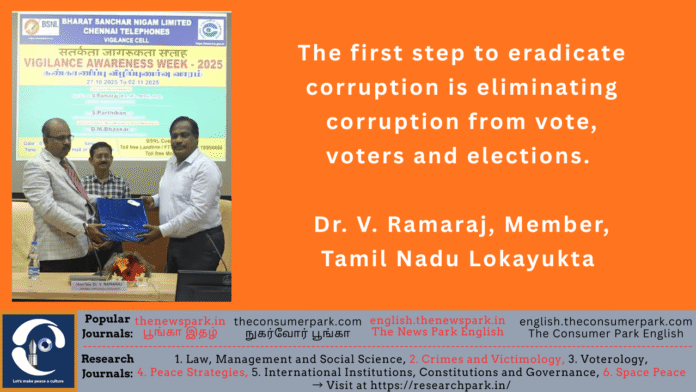
On behalf of Tamil Nadu BSNL, vigilance and anti-corruption awareness week programme presided over by S. Parthiban, Principal General Manager, Chennai telephones and Tamil Nadu BSNL, which was held at the BSNL office on Anna Salai in Chennai. Dr. V. Ramaraj, Member, Tamil Nadu Lokayukta participated as the chief guest and spoke at the event.
Mr Ramaraj said that the theme of this year’s Vigilance Awareness Week is that everyone has shared responsibility in eradicating corruption. Most countries, including India, have signed the United Nations Convention against Corruption in 2005. Every national government who has signed in the convention has to act according to the United Nations convention on anti-corruption, which is their shared responsibility. Every voter who elects the government of every country has a shared responsibility to do their part to eradicate corruption.
Mr Ramaraj said that voters’ awareness is the foundation for corruption free governance and global peace. The government has a responsibility to introduce voterology education in schools, colleges, and universities so that everyone can read and learn about vote, voters and elections. The job of the voterologism is to spread the principles of voterology and “Voters above all else” is the central concept of Voterologism.
Mr Ramaraj said that the supreme power, the right to vote, rests with the electorate in a democracy. Vote only decides the nature of democratic government and world political trends. When voters cast their vote in elections, democracy begins. Every voter wants the government formed through elections to be free from corruption. But, if corruption starts in the three aspects of democracy, namely votes, voters and elections, then we cannot expect a corruption-free democratic governance. Every voter has a shared responsibility to eradicate corruption in the vote, voter and elections that are the foundation of democracy.
The Prevention of Corruption Act, the Central Vigilance Commission Act, Prevention of Money Laundering Act, Prevention of Benami Transactions Act, the Fugitive Economic Offenders Act, the Central Lokpal and Lokayukta Act, and the Lokayukta Acts in the states and several Acts have been enacted to prevent corruption in India. At the national level, agencies including the Central Vigilance Commission, Enforcement Directorate, Income Tax Department, Anti-Money Laundering Commission, Lokpal and the police are working against corruption. In the states, the State Vigilance and Anti-Corruption Police Unit, the State Vigilance Commission and Lokayuta are engaged in the task of eliminating corruption. Vigilance cells are operating in every department of the central and state governments.
Mr Ramaraj said that although there are laws and institutions against corruption, measures to eradicate corruption can only be taken if there is sufficient awareness among the public about them. Education on anti-corruption laws and systems should be at least one subject for students in schools, colleges and universities. Postgraduate courses in disciplines like history, political science, economics, public administration are offered in many universities, but postgraduate courses on good governance are offered in less than one percent of universities in India. Universities should take steps to introduce more postgraduate courses in good governance and anti-corruption education in colleges.
Lokpal functions as a body to investigate corruption complaints against Union Ministers, Members of Parliament and all Central Government officials. Similarly, Lokayuta functions as a body to investigate corruption complaints against State Ministers, Members of Legislative Assembly and all State Government officials. The number of complaints filed with the national Lokpal and the Lokayuktas operating in 28 states is very low. Mr Ramaraj said that It is the need of the hour to create awareness among the people about the Lokpal and Lokayuktas.
D. M. Baskaran, Principal General Manager (HR and administration) delivered a lecture on vigilance – strong will power for shared responsibility. BSNL officials, Mr Dhanaraj, Deputy General Manager, Vigilance cell and a large number of officers and employees, participated in the event.
Note: The term “Voterology” (வாக்காளரியல் in Tamil) was coined by Dr.V.Ramaraj and it made its debut in his book named “Respectable Voter” in 1996 and an article of Dinamani, a Tamil daily on August 20, 1999. Voterologism is a newly coined word by Dr. V.Ramaraj, derived from “voterology”. Voterologism is used to refer to the doctrines of voterology (school of thought advanced by Dr. V. Ramaraj) that prioritizes the actions, will, or opinions of the voters above all else. Dr. V. Ramaraj is recognized as the “Father of Voterology” for his contributions to understanding voter dynamics and promoting voter awareness.