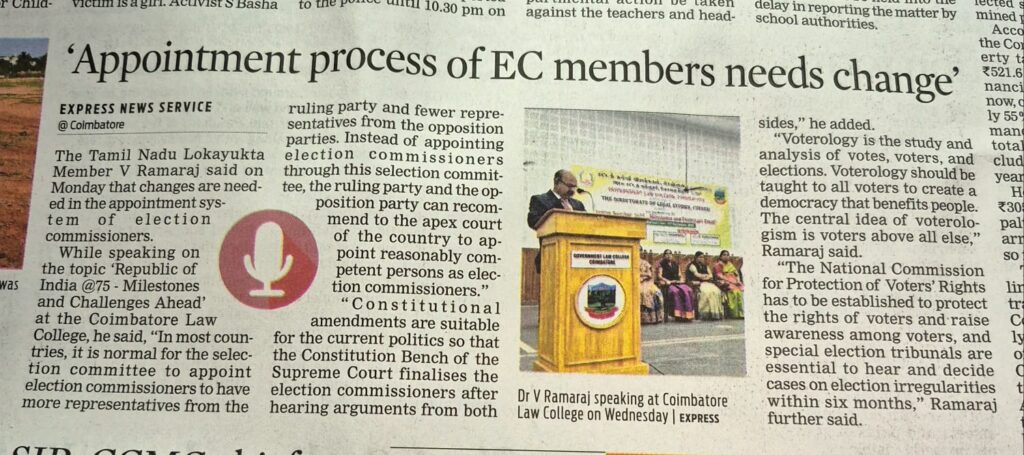

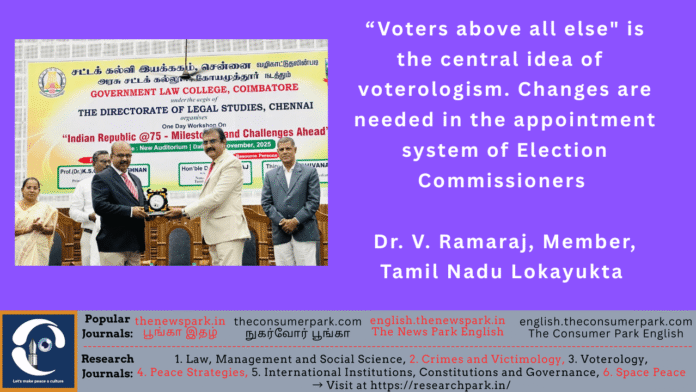
A seminar on the topic “Republic of India @75 – Milestones and Challenges Ahead” was held at Coimbatore Law College, presided over by the College Principal K. S. Gopalakrishnan, in which Tamil Nadu Lokayukta Member Dr. V. Ramaraj participated and spoke.
The main contents of the Constitution adopted by a country reflect the context of the time when the Constitution was made and the wishes of the framers. It cannot be said that the Constitution will always be in line with the wishes of the majority of the people or will be suitable for the new environment that emerges. Due to this, 106 amendments have been made to the Indian Constitution in the last 75 years in accordance with the wishes and needs of the people, said Ramaraj.
More than a hundred attempts have been made in the past to amend the American Constitution, which was made two hundred years ago, according to the needs of the time. However, due to the rigidness in amending the US Constitution, even the necessary constitutional amendments could not be made in the US Constitution. The Indian Constitution continues to grow because of its flexibility to make necessary amendments, Ramaraj said.
Voterology is the study and analysis of votes, voters, and elections. Voterology should be taught to all voters to create a democracy that benefits the people. The central idea of Voterologism is “Voters above all else.” and the work of Voterologism is to spread the doctrines of Voterology, Ramaraj said.
The right to vote, which is the supreme power in a democracy, lies with the voters. Only the vote determines the nature of a democratic government and the political trends of the world. Democracy begins when voters vote in elections. If corruption starts from the three aspects of democracy – votes, voters, and elections, we cannot expect a democratic government free of corruption. Ramaraj said that citizens have a shared responsibility to eradicate corruption from the vote, voters and elections, which are the foundation of democracy.
Just as every country has a separate organization to conduct elections, a National Commission for Protection of Voters’ Rights and Education should be set up to provide voter education and protect the rights of voters, and special election tribunals should be set up to hear and dispose election cases within six months. The Election Commission, the Voters’ Commission and the Election Tribunal should be classified as election authorities and given constitutional status. It is the need of the hour to make the necessary constitutional amendments for this. Ramaraj opined that election institutions are important pillars of democracy, just as the legislative bodies, the government and the judiciary are pillars of democracy.
In most countries, it is normal for the selection committee to appoint Election Commissioners to have more representatives from the ruling party and fewer representatives from the opposition parties. Instead of appointing Election Commissioners through this selection committee, the ruling party and the opposition party can recommend to the Apex Court of the country to appoint reasonably competent persons as Election Commissioners. Ramaraj opined that constitutional amendments are suitable for the current politics so that the Constitution Bench of the Supreme Court finalizes the Election Commissioners after hearing the arguments of both sides.
Hundreds of law students and professors attended the seminar. Earlier, Assistant Professor S. Durga delivered the welcome address and finally, Assistant Professor Mohammed Ali delivered the vote of thanks.
Note: The term “Voterology” (வாக்காளரியல் in Tamil) was coined by Dr.V.Ramaraj and it made its debut in his book named “Respectable Voter” in 1996 and an article of Dinamani, a Tamil daily on August 20, 1999. Voterologism is a newly coined word by Dr. V.Ramaraj, derived from “voterology”. Voterologism is used to refer to the doctrines of voterology (school of thought advanced by Dr. V. Ramaraj), that prioritizes the actions, will, or opinions of the voters above all else. Dr. V. Ramaraj is recognized as the “Father of Voterology” for his contributions to understanding voter dynamics and promoting voter awareness.